Slow Development Goals: 2030 Is Slipping Away
April 22by Bodh Maathura
You read the title right, the Sustainable Development Goals (SDG) have moved at a molasses-like pace toward 2030. The Asia and the Pacific SDG Progress Report 2026 states that, with “the current trajectory, the region will miss 103 of the 117 measurable targets. Existing data show that the region is on track to achieve only 14 targets by 2030, with seven SDGs having no targets on track.”
What’s even more striking is that in 2025, progress on several key indicators has reversed after accelerating in 2024. These include hunger and food security, equal access to education, fossil-fuel subsidies, justice for all, and debt sustainability, areas that are critical for equity across marginalized communities and vulnerable countries.
However, it’s not all doom and gloom. We have come very far in creating a multilateral system that has delivered progress and pulled millions out of poverty. But one thing is clear, the current system is too “slow” and needs to be recalibrated.
Voices from the Ground
With such a mission, the APFSD Youth Forum 2026 convened an intersectional group of over 705 young people from 38 countries and territories across the Asia and the Pacific region. These young people represented youth-led, youth-serving, feminist organisations, changemakers, social entrepreneurs, activists, and students who worked not only on policy, but directly hand in hand with their local communities.
From day one, both the frustration with the snail pace of progress and the lack of accountability of past generations in doing irreversible damage to the planet were clear. Yet, in each young person, there was that energy and drive that it is still not too late for change. This was evident when they shared stories of how, together with their communities, they were able to solve problems, from ensuring meals for school children to providing access to safe drinking water to entire villages.
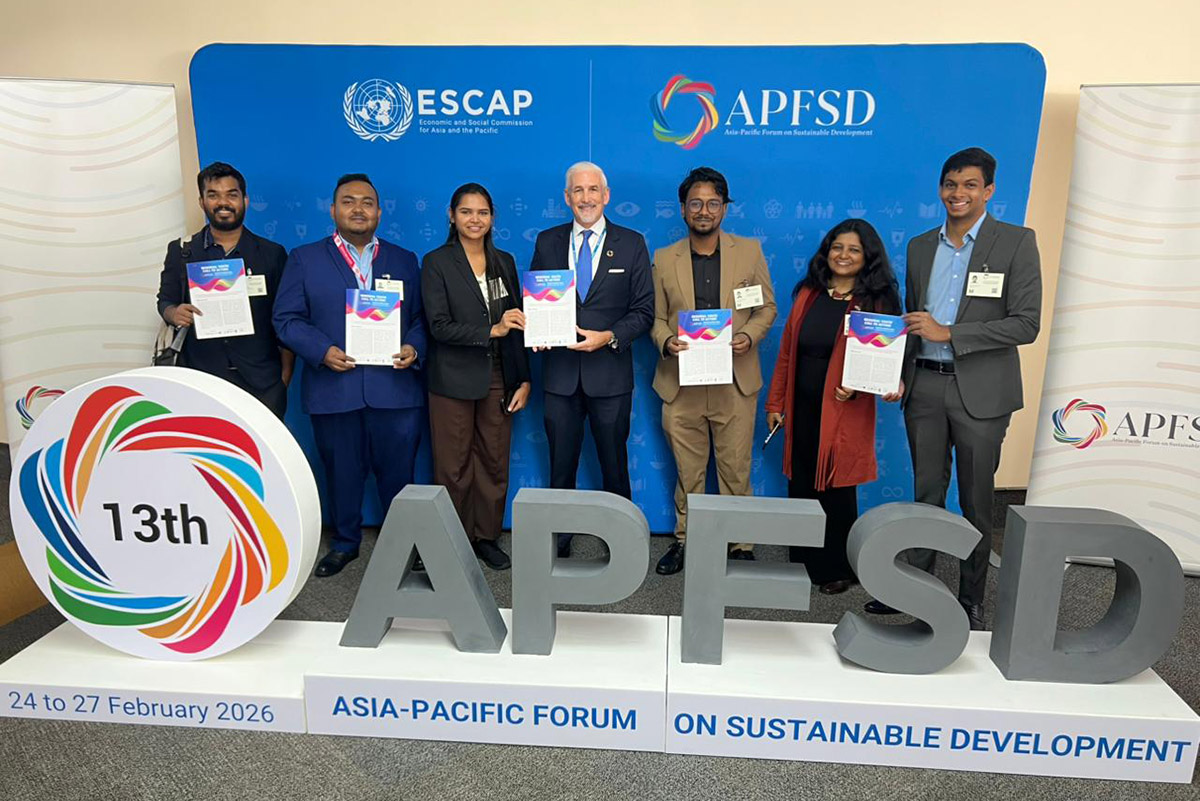
To share their efforts and raise their voices, the young people delivered a Regional Youth Call to Action to the 13th Asia Pacific Forum on Sustainable Development, outlining both their recommendations and demands, while also committing to the attainment of the Sustainable Development Goals. Their engagement did not stop there; they were also on the ground at both the APFSD People’s Forum and the intergovernmental forums, highlighting the specific needs and community-led recommendations of young people from across the Asia Pacific region.
Rethinking Development Design
Young people are calling for a “system reset” not because they disagree with the targets set by the SDGs, but because, through their lived experiences, they understand that when activities and programmes are designed, they are often done by alienating the very vulnerable people they hope to help. People and communities are prescribed solutions by donors, rather than the solutions being co-created.
While there may not, in all cases, be ill intentions, this undermines the very idea of empowerment, which should be to create an environment where people and communities are able to define what sustainable development means for them and how they want to achieve it. This top-down approach, not just between policymakers and citizens, but also between Global North and Global South countries, in both the development and operationalisation of the SDGs, has resulted in its mired pace.
Beyond Sustainability
With less than five years to go for Agenda 2030, we must envision a post-2030 agenda that fills these gaps. One that is locally led, with children, young people, women, and local communities in all their diversities at the heart of the design, championed by developing countries. This can be done only if we have each of these groups at an equitable drawing table.
Then, and only then, can we go beyond sustainable development to a set of Regenerative Development Goals that can be achieved. Because maintaining the world is no longer enough, we must restore it.