CultureEditor's PickEducation

My Many Dreams are in Many Languages

March 7th, 2026

by Jasmine Koria

My name is Jasmine, which in Anglicized Mandarin is mo li hua. I learned this on a recent visit to China, a few years after I finished processing the fact that my great, great (great-great) grandfather came to Samoa from Northern China to work a job he never left. There are days when I think, if I had lived a hundred years ago, I would have still had the same name, just in a different language.

I am a person who grew up in a poor Pacific country, and like most poor people, I have and have had many dreams. Orphans dream of their parents, or of having parents at all, and I am no exception.

I dream of my father in Gagana Samoa. When I was in Hawaii for the East-West Center’s Resilient Pacific Islands Leaders Fellowship in 2024, there was a discussion about the concept of a ‘translated self.’ Who do we become when we want people who don’t know our languages and customs to understand us? To accept, and hopefully, maybe even love us? It was years after my father’s untimely death when I realized he had lived the last two decades of his life like a whole day of communicating using only Duolingo. A Samoan boy who went to New Zealand for school as a teenager and was at first advised against joining ‘mainstream’ classes because ‘they are hard for you folks from the islands to understand,’ he was barely 15 when he began his transformation into the caricature I knew and loved.

My father’s name was ‘Eteuati’- Samoan for ‘Edward.’ Many people, even other Pacific islanders, often complained that his name had ‘too many vowels for its own good.’ He was gracious; in all the years I spent with him, I never heard him correct a person who spelled or pronounced his name as ‘Etuwati’ or ‘Etuati.’ Some took the liberty of just calling him ‘Ed’. I was in my early twenties, at university, when I found out that a lot of ‘Eteuatis’ go by ‘Ete’, honoring the Samoan-ness of their names. Among all the culprits who ever mispronounced my father’s name, my mother was chief. And so I learned another thing: my father had allowed himself to be translated so that his wife had a name to call him by. Love is a very ridiculous thing.
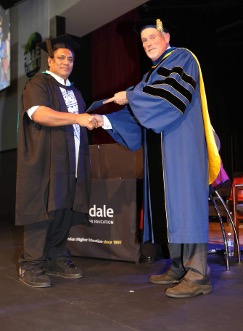
My late father, Eteuati Koria (left), receiving his Master of Education degree (Specialization: Leadership & Administration) from then-Avondale College[i] and Charles Stuart University in Sydney, Australia (Image by Avondale College of Higher Education). All his graduate and postgraduate work was in his second language, English.

My first language is neither English nor Gagana Samoa. It is Tok Pisin, Papua New Guinea Pidgin. My mother was Papua New Guinean. I spent the first year of my life hearing my (now retired) politician grandfather talk about changing the world in a language that is neither German nor Dutch nor quite English. My grandfather is chief of a proud, sporadic river people who live in and around what is known on maps as the Purari Delta, in the Gulf of P.N.G. His Tok Pisin is like the world’s most jovial sad song that you want to put into the chords of a guitar. Tok Pisin is a defiant language: I become a different person when I speak it. It must come from within you. You have to not care, just a little bit. Or else it’ll sound like you’re reading a script. It is also a brave language. Tok Pisin comes to me most clearly again when I am very happy or very sad, or very angry.

My grandmother comes from the mountains, a world away from my grandfather’s water-logged ‘kingdom’. Her Pidgin is full of rolling r’s, like the rocks on the steep climb up the Goroka terrain.

I dream of my mother in the lyrics of Tok Pisin songs. On a night when I was restlessly marking secondary school exams, my YouTube shuffled over to this song: Meri Baimuru, by Possum Mangi.

“Mi lukim meri Baimuru katim solwara I go.

Ayo susa, solwara ya, I no osem wara Kikori, nogut yu kisim bagarap.

Tingim pastaim na behain yu go.

Tutak I wok lo kam isi isi ya, taim sun I go down lo Daru Island.

Yu aburusim Kikori, Baimuru.[ii]

I saw the Baimuru girl fording across the ocean, going

Oh sister, this salt water is not like the rivers of Kikori

Be careful, lest you meet trouble

The darkness is coming, slowly

The sun sets over Daru Island,

As you sail past Kikori and Baimuru.

My mother was a Baimuru girl who went across the sea, out of Kikori and past Daru Island’s sunsets, and never returned home.
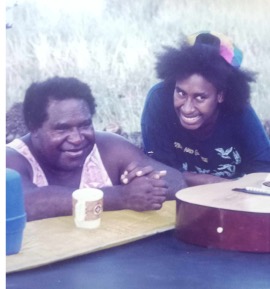
My late mother, Daisy Evara-Koria (right), with her father, retired statesman
Roy Evara OBE (Officer of the Most Excellent Order of the British Empire for Services to Education and Politics).

When I was a teacher, I taught a lot of the time in the language I knew my students dreamt in, Gagana Samoa. I wanted and still want the youth of Oceania to know that their dreams matter, and our languages are important and intelligent and worthy. The highlight of my career was explaining Shakespeare’s Romeo and Juliet in Samoan. In our native language, the balcony scene sounds exactly like what its modern-day equivalent would be: two silly kids talking on Messenger or TikTok, hoping no one screenshots anything. I remember my senior English class laughing about something along the lines of, “It is the East, and hopefully none of these messages ever see the light of day!”

I write international policies, reports, books and academic articles in English. Let us say, I dream aloud in English. It is an imposing language in the Pacific, just like colonialism was. Sometimes people treat you differently  – better, more carefully  – when you speak good English. My own command of English feels often like a gift, a weapon and an obligation. The first English I learned properly came from Alan Paton and Chinua Achebe’s books. Heavy English about war and prayer and loneliness in beautiful places. The kind of English I was taught to dream in is an English of hills and coats and lost children who go out into the cities and forget their parents. It is the English of funeral eulogies and being unable to say ‘I love you’ but doing everything in one’s power for the people in one’s life. Mine is the English of old Christian hymns that taught me words like ‘doeth’, ‘pavilion’ and ‘countenance’. Pacific English is that. It is now, despite our misgivings in the 1930s and 1940s, our own.

My dreams in English have taken me to some impossible places. In their lives, my parents never traveled out of the Pacific. When I looked out of that beast of an Emirates plane that took me on my first Europe trip, I cried uncontrollably at my first sight of the Swiss Alps. My father was a lifelong lover of music; he used to play the piano and sing in his lyrical tenor English, ‘The hills are alive, with the sound of music’. He was no longer alive when I went to see the hills. George Washington looked down upon me, lazily, from the ceiling of the Capitol Hill Visitor Center in Washington D.C. George Washington, ascended to what I know is an English-speaking heaven, more than ever now. As a child I used to look at that picture in textbooks and think it was Jesus. Mistranslation is often corrected only by experience.
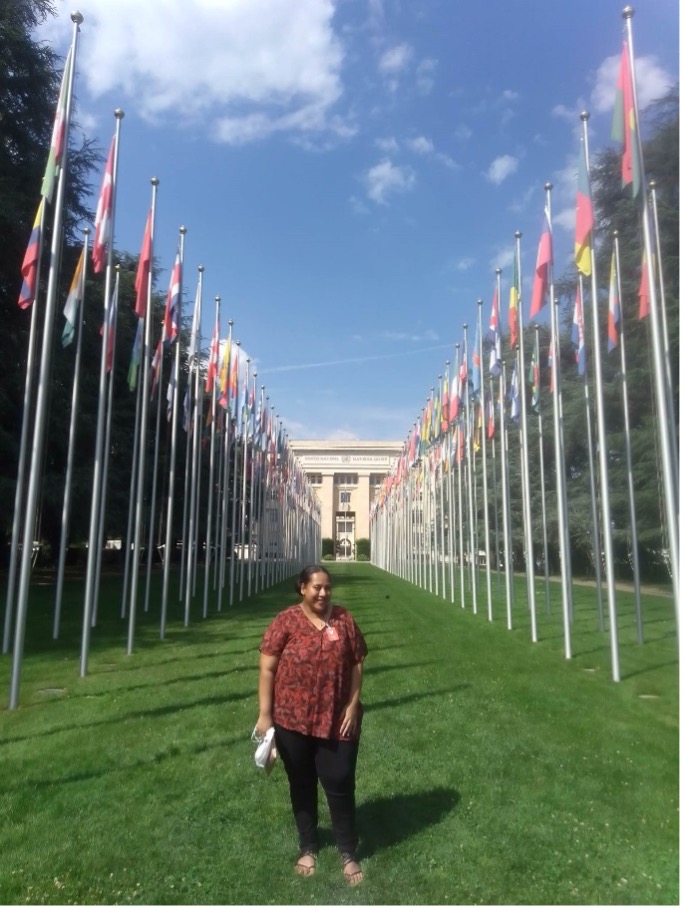
After a tour of the United Nations Headquarters in Geneva, Switzerland.
Image by Marissa To’omata of the Samoa Ministry of Foreign Affairs & Trade (2023).
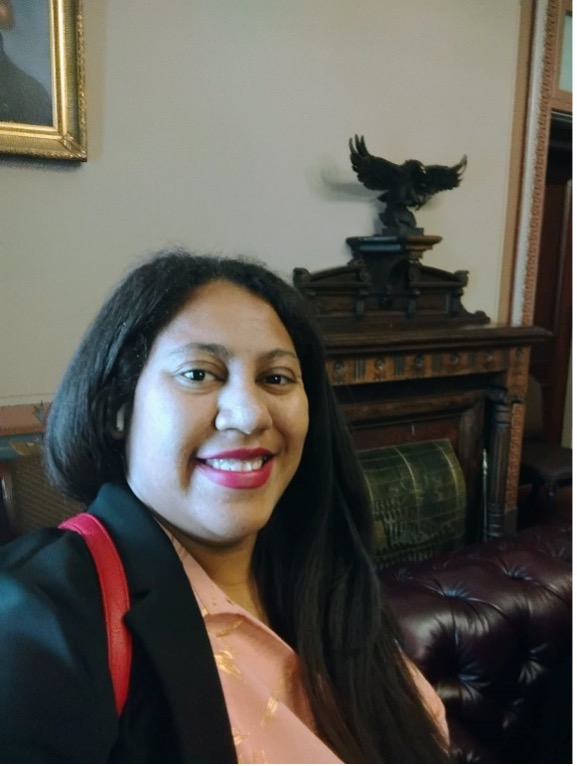
A selfie in the White House, Washington D.C., after meeting with members of President Biden’s National Security Council
and National Economic Council (2024).

Sometimes I was the only brown student in my English Literature undergraduate classes in New Zealand. People gave me well-meaning and unsolicited advice. “You sure you want to read John Keats? He’s very complicated.” My dreams kept me going there. When I was an English lecturer at the National University of Samoa, I realized that if someone calls something ‘complicated’, they probably can’t explain it very well themselves.

There are epitaphs on the old graves in Wellington, New Zealand. Graves from the 1800s, settler season. “In the midst of life, we are in death.” When I finally came to terms with my million dreams having their own languages, I turned that phrase on its head. In the midst of death, we are in life. So long lives this, for where there is life, there are dreams. And where there are dreams, there is a future.


[i] This Seventh-day Adventist educational institution is now officially known as ‘Avondale University’

[ii] Produced by CHM Supersound and released in 2018

Share

About the author

Jasmine Koria

Jasmine Koria has a keen interest in youth work and community development. She has served as an educator, educational administrator and educational consultant for several years. She is also a published writer. Aside from teaching and writing, Jasmine enjoys serving Samoa and the Pacific in various international spaces and diplomatic capacities. Her ambitions include helping to raise literacy levels in the developing Pacific and strengthening the relationships between Commonwealth countries.

Submit your content

Submit a video
Submit an article

by Jasmine Koria

My name is Jasmine, which in Anglicized Mandarin is mo li hua. I learned this on a recent visit to China, a few years after I finished processing the fact that my great, great (great-great) grandfather came to Samoa from Northern China to work a job he never left. There are days when I think, if I had lived a hundred years ago, I would have still had the same name, just in a different language.

I am a person who grew up in a poor Pacific country, and like most poor people, I have and have had many dreams. Orphans dream of their parents, or of having parents at all, and I am no exception.

I dream of my father in Gagana Samoa. When I was in Hawaii for the East-West Center’s Resilient Pacific Islands Leaders Fellowship in 2024, there was a discussion about the concept of a ‘translated self.’ Who do we become when we want people who don’t know our languages and customs to understand us? To accept, and hopefully, maybe even love us? It was years after my father’s untimely death when I realized he had lived the last two decades of his life like a whole day of communicating using only Duolingo. A Samoan boy who went to New Zealand for school as a teenager and was at first advised against joining ‘mainstream’ classes because ‘they are hard for you folks from the islands to understand,’ he was barely 15 when he began his transformation into the caricature I knew and loved.

My father’s name was ‘Eteuati’- Samoan for ‘Edward.’ Many people, even other Pacific islanders, often complained that his name had ‘too many vowels for its own good.’ He was gracious; in all the years I spent with him, I never heard him correct a person who spelled or pronounced his name as ‘Etuwati’ or ‘Etuati.’ Some took the liberty of just calling him ‘Ed’. I was in my early twenties, at university, when I found out that a lot of ‘Eteuatis’ go by ‘Ete’, honoring the Samoan-ness of their names. Among all the culprits who ever mispronounced my father’s name, my mother was chief. And so I learned another thing: my father had allowed himself to be translated so that his wife had a name to call him by. Love is a very ridiculous thing.

My late father, Eteuati Koria (left), receiving his Master of Education degree (Specialization: Leadership & Administration) from then-Avondale College[i] and Charles Stuart University in Sydney, Australia (Image by Avondale College of Higher Education). All his graduate and postgraduate work was in his second language, English.

My first language is neither English nor Gagana Samoa. It is Tok Pisin, Papua New Guinea Pidgin. My mother was Papua New Guinean. I spent the first year of my life hearing my (now retired) politician grandfather talk about changing the world in a language that is neither German nor Dutch nor quite English. My grandfather is chief of a proud, sporadic river people who live in and around what is known on maps as the Purari Delta, in the Gulf of P.N.G. His Tok Pisin is like the world’s most jovial sad song that you want to put into the chords of a guitar. Tok Pisin is a defiant language: I become a different person when I speak it. It must come from within you. You have to not care, just a little bit. Or else it’ll sound like you’re reading a script. It is also a brave language. Tok Pisin comes to me most clearly again when I am very happy or very sad, or very angry.

My grandmother comes from the mountains, a world away from my grandfather’s water-logged ‘kingdom’. Her Pidgin is full of rolling r’s, like the rocks on the steep climb up the Goroka terrain.

I dream of my mother in the lyrics of Tok Pisin songs. On a night when I was restlessly marking secondary school exams, my YouTube shuffled over to this song: Meri Baimuru, by Possum Mangi.

“Mi lukim meri Baimuru katim solwara I go.

Ayo susa, solwara ya, I no osem wara Kikori, nogut yu kisim bagarap.

Tingim pastaim na behain yu go.

Tutak I wok lo kam isi isi ya, taim sun I go down lo Daru Island.

Yu aburusim Kikori, Baimuru.[ii]

I saw the Baimuru girl fording across the ocean, going

Oh sister, this salt water is not like the rivers of Kikori

Be careful, lest you meet trouble

The darkness is coming, slowly

The sun sets over Daru Island,

As you sail past Kikori and Baimuru.

My mother was a Baimuru girl who went across the sea, out of Kikori and past Daru Island’s sunsets, and never returned home.

My late mother, Daisy Evara-Koria (right), with her father, retired statesman
Roy Evara OBE (Officer of the Most Excellent Order of the British Empire for Services to Education and Politics).

When I was a teacher, I taught a lot of the time in the language I knew my students dreamt in, Gagana Samoa. I wanted and still want the youth of Oceania to know that their dreams matter, and our languages are important and intelligent and worthy. The highlight of my career was explaining Shakespeare’s Romeo and Juliet in Samoan. In our native language, the balcony scene sounds exactly like what its modern-day equivalent would be: two silly kids talking on Messenger or TikTok, hoping no one screenshots anything. I remember my senior English class laughing about something along the lines of, “It is the East, and hopefully none of these messages ever see the light of day!”

I write international policies, reports, books and academic articles in English. Let us say, I dream aloud in English. It is an imposing language in the Pacific, just like colonialism was. Sometimes people treat you differently  – better, more carefully  – when you speak good English. My own command of English feels often like a gift, a weapon and an obligation. The first English I learned properly came from Alan Paton and Chinua Achebe’s books. Heavy English about war and prayer and loneliness in beautiful places. The kind of English I was taught to dream in is an English of hills and coats and lost children who go out into the cities and forget their parents. It is the English of funeral eulogies and being unable to say ‘I love you’ but doing everything in one’s power for the people in one’s life. Mine is the English of old Christian hymns that taught me words like ‘doeth’, ‘pavilion’ and ‘countenance’. Pacific English is that. It is now, despite our misgivings in the 1930s and 1940s, our own.

My dreams in English have taken me to some impossible places. In their lives, my parents never traveled out of the Pacific. When I looked out of that beast of an Emirates plane that took me on my first Europe trip, I cried uncontrollably at my first sight of the Swiss Alps. My father was a lifelong lover of music; he used to play the piano and sing in his lyrical tenor English, ‘The hills are alive, with the sound of music’. He was no longer alive when I went to see the hills. George Washington looked down upon me, lazily, from the ceiling of the Capitol Hill Visitor Center in Washington D.C. George Washington, ascended to what I know is an English-speaking heaven, more than ever now. As a child I used to look at that picture in textbooks and think it was Jesus. Mistranslation is often corrected only by experience.

After a tour of the United Nations Headquarters in Geneva, Switzerland.
Image by Marissa To’omata of the Samoa Ministry of Foreign Affairs & Trade (2023).
A selfie in the White House, Washington D.C., after meeting with members of President Biden’s National Security Council
and National Economic Council (2024).

Sometimes I was the only brown student in my English Literature undergraduate classes in New Zealand. People gave me well-meaning and unsolicited advice. “You sure you want to read John Keats? He’s very complicated.” My dreams kept me going there. When I was an English lecturer at the National University of Samoa, I realized that if someone calls something ‘complicated’, they probably can’t explain it very well themselves.

There are epitaphs on the old graves in Wellington, New Zealand. Graves from the 1800s, settler season. “In the midst of life, we are in death.” When I finally came to terms with my million dreams having their own languages, I turned that phrase on its head. In the midst of death, we are in life. So long lives this, for where there is life, there are dreams. And where there are dreams, there is a future.


[i] This Seventh-day Adventist educational institution is now officially known as ‘Avondale University’

[ii] Produced by CHM Supersound and released in 2018