Commonwealth Games 2026Sport for Development & Peace
Home Our latest stories FeatureSports One Nation, Eight Teams: Rethinking Australia’s Commonwealth Games Success

One Nation, Eight Teams: Rethinking Australia’s Commonwealth Games Success

October 6th, 2026

by Cody Mitchell

As the dust settles on the 2026 Glasgow Commonwealth Games, Australia celebrates a particularly strong performance — topping the medal tally for a third consecutive Commonwealth Games.

Despite disappointing results in some events — most notably the Diamonds netball team’s ‘shock’ bronze medal, after entering the Games as strong gold-medal favourites — Team Australia hauled in a massive 70 gold medals (with 45 silver and 56 bronze), with the next strongest country being England, on just 29 gold medals.

Australia also enjoyed its most successful single day in Commonwealth Games history (the last being in 1950), winning seven gold medals as part of a 17-medal haul. For two events, the Aussies swept the podium — winning gold, silver, and bronze.

For a country of Australia’s size, this is an impressive feat.

For context, while Australia (27 million) has a comfortably larger population than either Scotland (5.5 million) or New Zealand (5.4 million), it is much smaller than the other Commonwealth frontrunners on the Games Medal Table.

England’s population is 56 million, while Canada’s is 42 million and South Africa’s is 65 million. At the other end of the scale, India has a population of around 1.46 billion, while around 238 to 245 million people live in Nigeria.

However, what would the results be if Australia competed as individual States? Similar to how the United Kingdom competes as England, Scotland, Wales, Northern Ireland, etc., during the Commonwealth Games, what if we split Australia up into New South Wales, Victoria, Queensland, South Australia, Western Australia, Tasmania, and the two territories: the Northern Territory and the Australian Capital Territory?

This experiment makes the population disparity even more stark.
New South Wales (NSW), Australia’s largest state, has around 8.6 million people — still larger than New Zealand or Scotland, but not by a lot.

Victoria has a population of around 7.1 million, while Queensland (QLD) has just 5.7 million.

Just over 3 million people live in Western Australia (WA), while South Australia (SA) has a population of less than 2 million.

Tasmania (TAS), Australia’s smallest state, is home to just over 500,000 people, while the Northern Territory (NT) has a population of around half that number.

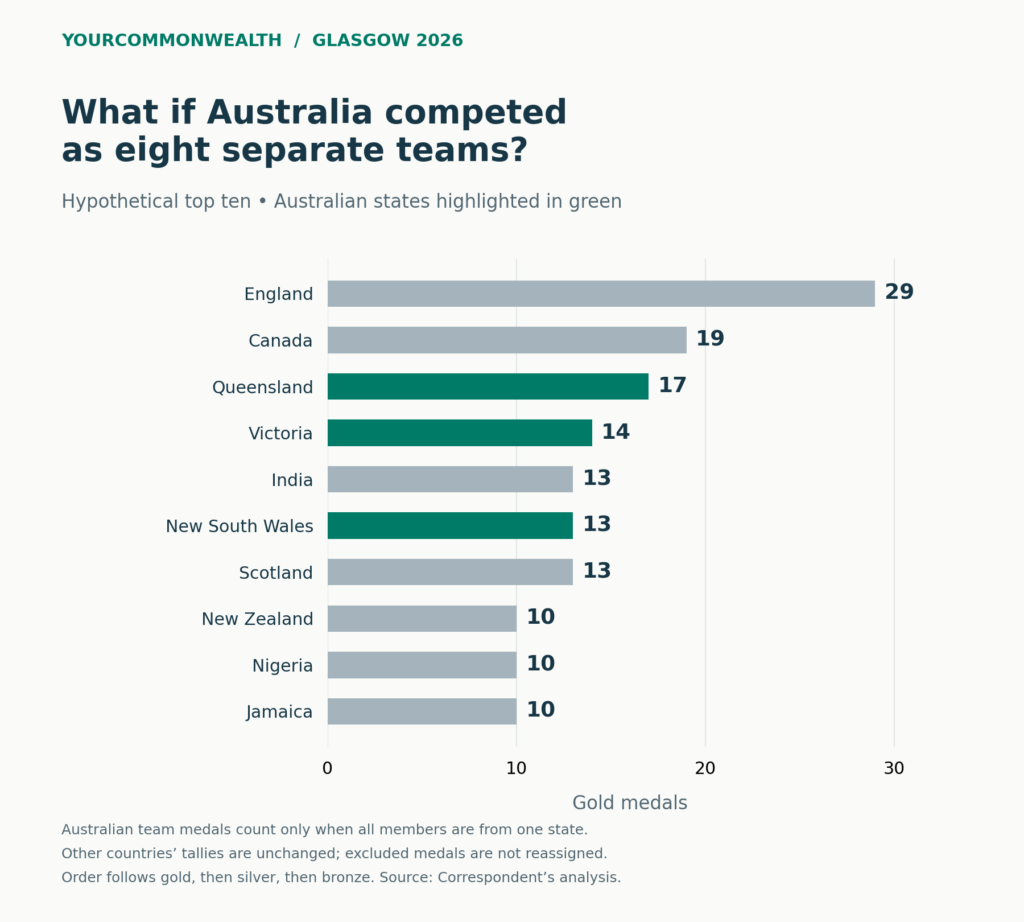
Here are the numbers if you count Australian athletes according to their state of birth (or, in the case of migrants to Australia, their state of residence).
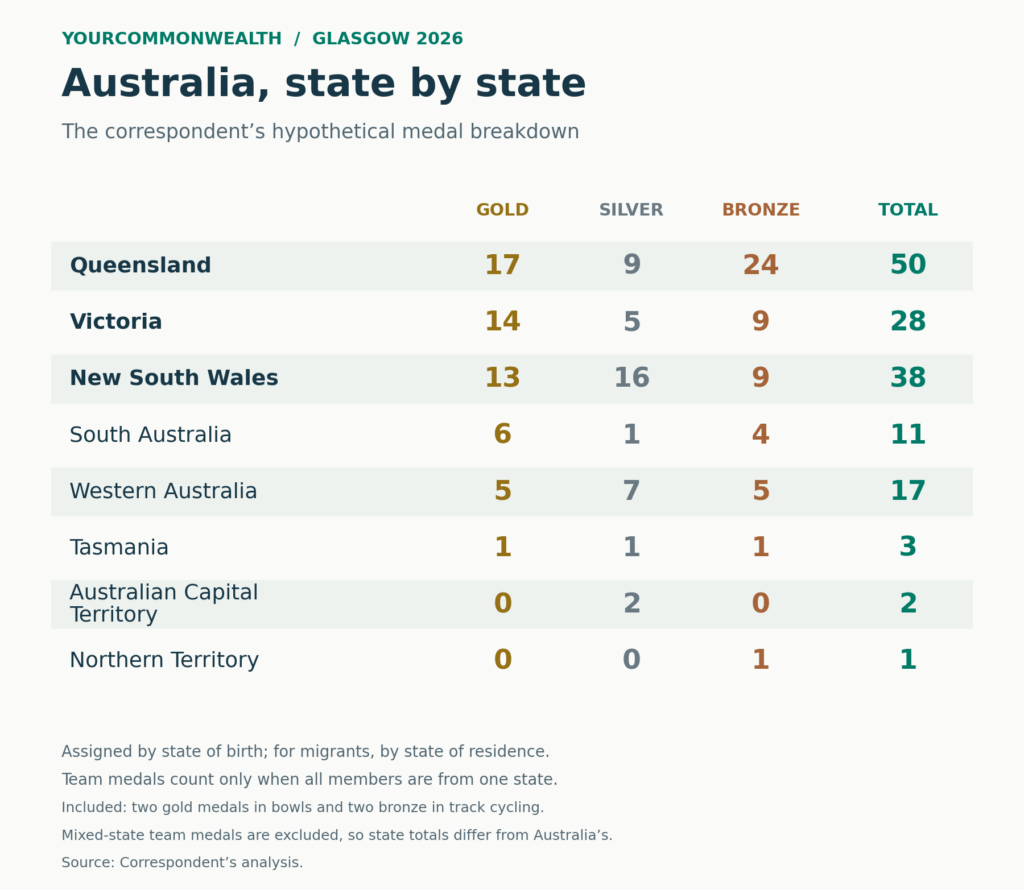
In this hypothetical scenario, Queensland would be the most successful Australian state at the Games, due largely to the strong presence of QLD swimmers in the national team.

Winning 17 gold medals, the QLD team would rank third on the tally — just two gold medals behind Canada’s national team.

With 14 gold medals, Victoria’s team would rank fourth globally — three gold behind QLD but one gold medal ahead of India, although winning far fewer medals overall (28 to India’s 39).

Australia’s largest state, New South Wales, would rank sixth (with 13 gold) — one silver medal behind India (and on an almost identical total medal tally), but ahead of Scotland (13) as well as New Zealand (10), Nigeria (10), and Jamaica (10).

The smaller Australian states of South Australia (6) and Western Australia (5) would also acquit themselves well — ranking fourteenth and fifteenth, respectively.

Tasmania (1) would sit in equal twentieth position with Cameroon, while even the ACT (=26th) and NT (=32nd) would come away with medals — two silver and one bronze, respectively.

Australia may compete as a single nation, but its sporting success is built on talent from every corner of the country. Even if split into eight teams, the green and gold would remain a formidable force at the Commonwealth Games.


Share

About the author

Cody Mitchell

Cody Mitchell graduated from the University of New England, where he studied history and politics; and Monash University, where he did postgraduate coursework in marketing and communications; and the Lachlan Macquarie Institute. A prolific writer, he is the founding editor of the educational blog History’s Page (https://historyspage.com/) and has had his work published in a number of academic journals and news sites. Cody currently works as the media advisor for an Australian federal senator.

Related articles

View all

Submit your content

Submit a video
Submit an article

by Cody Mitchell

As the dust settles on the 2026 Glasgow Commonwealth Games, Australia celebrates a particularly strong performance — topping the medal tally for a third consecutive Commonwealth Games.

Despite disappointing results in some events — most notably the Diamonds netball team’s ‘shock’ bronze medal, after entering the Games as strong gold-medal favourites — Team Australia hauled in a massive 70 gold medals (with 45 silver and 56 bronze), with the next strongest country being England, on just 29 gold medals.

Australia also enjoyed its most successful single day in Commonwealth Games history (the last being in 1950), winning seven gold medals as part of a 17-medal haul. For two events, the Aussies swept the podium — winning gold, silver, and bronze.

For a country of Australia’s size, this is an impressive feat.

For context, while Australia (27 million) has a comfortably larger population than either Scotland (5.5 million) or New Zealand (5.4 million), it is much smaller than the other Commonwealth frontrunners on the Games Medal Table.

England’s population is 56 million, while Canada’s is 42 million and South Africa’s is 65 million. At the other end of the scale, India has a population of around 1.46 billion, while around 238 to 245 million people live in Nigeria.

However, what would the results be if Australia competed as individual States? Similar to how the United Kingdom competes as England, Scotland, Wales, Northern Ireland, etc., during the Commonwealth Games, what if we split Australia up into New South Wales, Victoria, Queensland, South Australia, Western Australia, Tasmania, and the two territories: the Northern Territory and the Australian Capital Territory?

This experiment makes the population disparity even more stark.

New South Wales (NSW), Australia’s largest state, has around 8.6 million people — still larger than New Zealand or Scotland, but not by a lot.

Victoria has a population of around 7.1 million, while Queensland (QLD) has just 5.7 million.

Just over 3 million people live in Western Australia (WA), while South Australia (SA) has a population of less than 2 million.

Tasmania (TAS), Australia’s smallest state, is home to just over 500,000 people, while the Northern Territory (NT) has a population of around half that number.

Here are the numbers if you count Australian athletes according to their state of birth (or, in the case of migrants to Australia, their state of residence).

In this hypothetical scenario, Queensland would be the most successful Australian state at the Games, due largely to the strong presence of QLD swimmers in the national team.

Winning 17 gold medals, the QLD team would rank third on the tally — just two gold medals behind Canada’s national team.

With 14 gold medals, Victoria’s team would rank fourth globally — three gold behind QLD but one gold medal ahead of India, although winning far fewer medals overall (28 to India’s 39).

Australia’s largest state, New South Wales, would rank sixth (with 13 gold) — one silver medal behind India (and on an almost identical total medal tally), but ahead of Scotland (13) as well as New Zealand (10), Nigeria (10), and Jamaica (10).

The smaller Australian states of South Australia (6) and Western Australia (5) would also acquit themselves well — ranking fourteenth and fifteenth, respectively.

Tasmania (1) would sit in equal twentieth position with Cameroon, while even the ACT (=26th) and NT (=32nd) would come away with medals — two silver and one bronze, respectively.

Australia may compete as a single nation, but its sporting success is built on talent from every corner of the country. Even if split into eight teams, the green and gold would remain a formidable force at the Commonwealth Games.