Middle EastPeace and JusticeSmall States
Home Our latest stories Conflict and ViolenceDiplomacyGeoPoliticsMiddle East The Strategic Dilemma of Cyprus in the Eastern Mediterranean

The Strategic Dilemma of Cyprus in the Eastern Mediterranean

March 4th, 2026

by Katerina Panagi

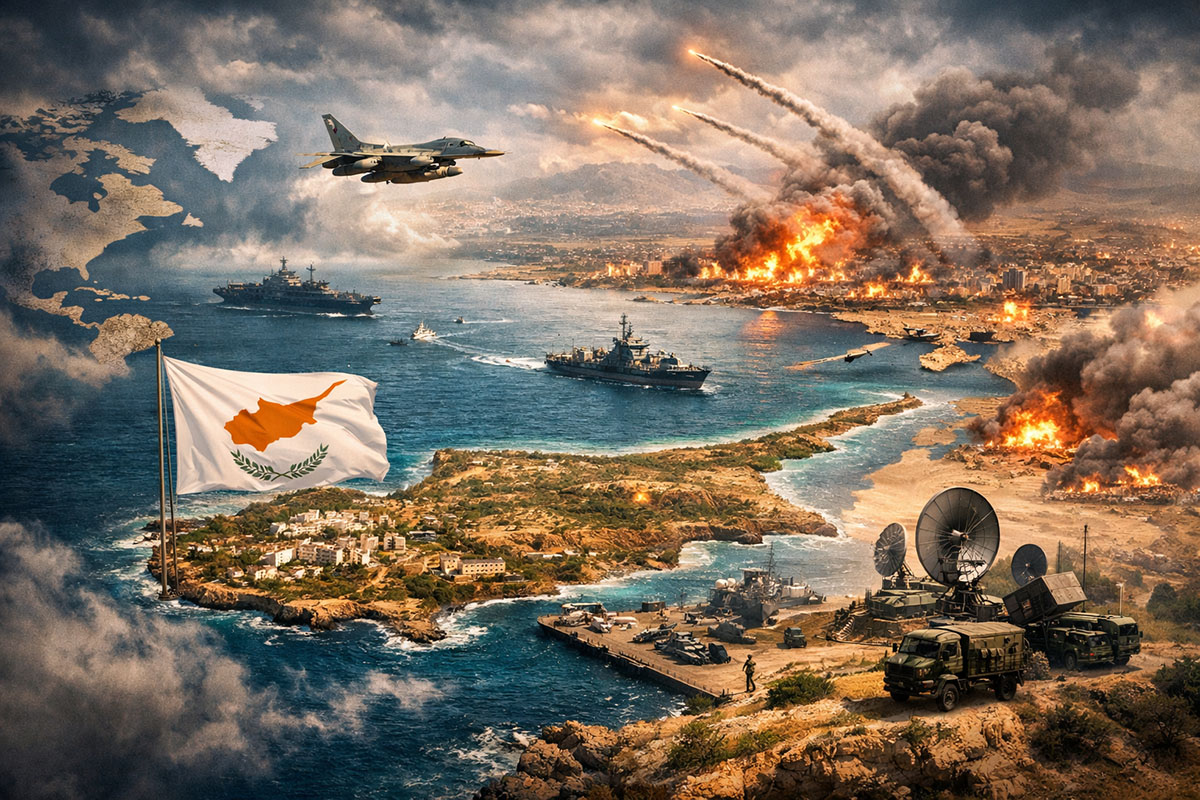
The geographic fate of Cyprus has always been its most potent double-edged sword. Situated at the maritime crossroads of Europe, Africa, and Asia, the island has historically functioned as a vital meeting point for trade and diplomacy. However, as the Middle East tensions of early 2026 reach a boiling point, this proximity has transformed the Republic of Cyprus (RoC) into a focal point of regional instability. Following the significant military escalations between Western powers and Iranian-aligned forces in February 2026, the island is no longer merely a spectator to the chaos of the Levant, but a primary actor caught between its humanitarian aspirations and its involuntary role as a military staging ground.

The primary tension defining the current Cypriot dilemma is the legal and functional duality of the island’s territory. While the RoC maintains a policy of neutrality and humanitarian outreach, it remains physically intertwined with the British Sovereign Base Areas (SBAs) of Akrotiri and Dhekelia. As noted by Christou (2024), the 1960 Treaty of Establishment grants the United Kingdom sovereign rights over these installations, which the British government has utilized to support United States-led offensive operations in the current conflict. This arrangement creates a significant security paradox; while President Nikos Christodoulides has repeatedly stated that the Republic is not involved in any military strikes, the drone attack on RAF Akrotiri on March 1, 2026, demonstrated that regional adversaries like the Islamic Revolutionary Guard Corps (IRGC) do not distinguish between the Republic’s soil and the British military enclaves (European Union Institute for Security Studies [EUISS], 2026).

This security crisis coincides with Cyprus holding the rotating Presidency of the Council of the European Union for the first half of 2026. Nicosia originally intended to use this platform to promote the Amalthea Initiative, a maritime corridor designed to provide sustained aid to Gaza and stabilize the Eastern Mediterranean through energy cooperation (Ministry of Foreign Affairs of Cyprus, 2025). Instead, the presidency has been forced into a ‘crisis management’ mode. The strategic dilemma is further sharpened by the island’s economic vulnerability. The tourism sector, which accounts for nearly 15% of the national GDP, has seen a sharp decline in bookings for the 2026 season as international carriers reroute flights to avoid the increasingly contested airspace of the Eastern Levantine Basin (Cyprus Statistical Service, 2026).

Furthermore, the energy security of the Eastern Mediterranean is at a standstill. Projects like the Great Sea Interconnector, meant to link the electricity grids of Israel, Cyprus, and Greece, are currently stalled due to the presence of hostile naval assets and the threat of sabotage in the Exclusive Economic Zone (Stefanidis, 2025). This leaves Cyprus in a precarious position where it is viewed by the West as an ‘unsinkable aircraft carrier’ for power projection, while its local population faces the direct economic and physical consequences of being a frontline state. The resolution of this dilemma requires a fundamental reassessment of how the European Union protects its most exposed member state from the spillover of a war it did not choose to join.

Ultimately, the events of March 2026 have demonstrated that the ‘strategic depth’ Cyprus offers the West comes at a steep price for the Republic’s own domestic stability. The strike on RAF Akrotiri and the subsequent arrival of Greek F-16s and frigates to bolster the island’s air defense signal a transition from a period of diplomatic mediation to one of active military deterrence (Gov.cy, 2026). While Nicosia remains committed to the ESTIA plan and its humanitarian obligations, the island’s proximity to the ‘Shahed-range’ of regional proxies makes its dilemma increasingly difficult to manage. For Cyprus to thrive, it must successfully navigate its 2026 EU Presidency by securing a commitment from its Western partners that its territory will not be used to ignite further regional fires. Without such assurances, the island risks becoming a permanent casualty of its own geography, caught in the crossfire of a conflict that its sovereign government has worked tirelessly to avoid (Stefanidis, 2025).

References

Christou, G. (2024). The sovereignty paradox: British bases and Cypriot foreign policy. Mediterranean Quarterly Press.

Cyprus Statistical Service. (2026). Monthly tourism and economic impact report: Q1 2026 update. Government Printing Office.

European Union Institute for Security Studies. (2026). The Eastern Mediterranean flashpoint: Security implications for the 2026 EU Presidency. EUISS Publications.

Ministry of Foreign Affairs of Cyprus. (2025). The Amalthea Initiative: A blueprint for maritime humanitarian corridors. Press and Information Office.

Stefanidis, M. (2025). Energy security and naval tension in the Levantine Basin. Journal of Maritime Geopolitics, 12(3), 45-62.

Share

About the author

Katerina Panagi

Katerina Panagi is a full-time Project Manager and Researcher at CARDET, an independent, non-profit, non-governmental, research and development organization based in Cyprus. She is also a part-time freelance journalist in Cyprus. As a researcher, she is a goal oriented person. She likes learning new things each day and being the best version of herself. Since she believes in lifelong learning, her ambitions are to advance her skills, knowledge and herself as much as she can, but also volunteer and gain further experience.

Related articles

Peace BuildingPeace and JusticeYouth NetworksYouth PolicyYouth Work
Environment & Climate ChangeGovernanceHistoryPeace BuildingPeace and Justice
View all

Submit your content

Submit a video
Submit an article

by Katerina Panagi

The geographic fate of Cyprus has always been its most potent double-edged sword. Situated at the maritime crossroads of Europe, Africa, and Asia, the island has historically functioned as a vital meeting point for trade and diplomacy. However, as the Middle East tensions of early 2026 reach a boiling point, this proximity has transformed the Republic of Cyprus (RoC) into a focal point of regional instability. Following the significant military escalations between Western powers and Iranian-aligned forces in February 2026, the island is no longer merely a spectator to the chaos of the Levant, but a primary actor caught between its humanitarian aspirations and its involuntary role as a military staging ground.

The primary tension defining the current Cypriot dilemma is the legal and functional duality of the island’s territory. While the RoC maintains a policy of neutrality and humanitarian outreach, it remains physically intertwined with the British Sovereign Base Areas (SBAs) of Akrotiri and Dhekelia. As noted by Christou (2024), the 1960 Treaty of Establishment grants the United Kingdom sovereign rights over these installations, which the British government has utilized to support United States-led offensive operations in the current conflict. This arrangement creates a significant security paradox; while President Nikos Christodoulides has repeatedly stated that the Republic is not involved in any military strikes, the drone attack on RAF Akrotiri on March 1, 2026, demonstrated that regional adversaries like the Islamic Revolutionary Guard Corps (IRGC) do not distinguish between the Republic’s soil and the British military enclaves (European Union Institute for Security Studies [EUISS], 2026).

This security crisis coincides with Cyprus holding the rotating Presidency of the Council of the European Union for the first half of 2026. Nicosia originally intended to use this platform to promote the Amalthea Initiative, a maritime corridor designed to provide sustained aid to Gaza and stabilize the Eastern Mediterranean through energy cooperation (Ministry of Foreign Affairs of Cyprus, 2025). Instead, the presidency has been forced into a ‘crisis management’ mode. The strategic dilemma is further sharpened by the island’s economic vulnerability. The tourism sector, which accounts for nearly 15% of the national GDP, has seen a sharp decline in bookings for the 2026 season as international carriers reroute flights to avoid the increasingly contested airspace of the Eastern Levantine Basin (Cyprus Statistical Service, 2026).

Furthermore, the energy security of the Eastern Mediterranean is at a standstill. Projects like the Great Sea Interconnector, meant to link the electricity grids of Israel, Cyprus, and Greece, are currently stalled due to the presence of hostile naval assets and the threat of sabotage in the Exclusive Economic Zone (Stefanidis, 2025). This leaves Cyprus in a precarious position where it is viewed by the West as an ‘unsinkable aircraft carrier’ for power projection, while its local population faces the direct economic and physical consequences of being a frontline state. The resolution of this dilemma requires a fundamental reassessment of how the European Union protects its most exposed member state from the spillover of a war it did not choose to join.

Ultimately, the events of March 2026 have demonstrated that the ‘strategic depth’ Cyprus offers the West comes at a steep price for the Republic’s own domestic stability. The strike on RAF Akrotiri and the subsequent arrival of Greek F-16s and frigates to bolster the island’s air defense signal a transition from a period of diplomatic mediation to one of active military deterrence (Gov.cy, 2026). While Nicosia remains committed to the ESTIA plan and its humanitarian obligations, the island’s proximity to the ‘Shahed-range’ of regional proxies makes its dilemma increasingly difficult to manage. For Cyprus to thrive, it must successfully navigate its 2026 EU Presidency by securing a commitment from its Western partners that its territory will not be used to ignite further regional fires. Without such assurances, the island risks becoming a permanent casualty of its own geography, caught in the crossfire of a conflict that its sovereign government has worked tirelessly to avoid (Stefanidis, 2025).

References

Christou, G. (2024). The sovereignty paradox: British bases and Cypriot foreign policy. Mediterranean Quarterly Press.

Cyprus Statistical Service. (2026). Monthly tourism and economic impact report: Q1 2026 update. Government Printing Office.

European Union Institute for Security Studies. (2026). The Eastern Mediterranean flashpoint: Security implications for the 2026 EU Presidency. EUISS Publications.

Ministry of Foreign Affairs of Cyprus. (2025). The Amalthea Initiative: A blueprint for maritime humanitarian corridors. Press and Information Office.

Stefanidis, M. (2025). Energy security and naval tension in the Levantine Basin. Journal of Maritime Geopolitics, 12(3), 45-62.